Updated November 5, 2026. Results are unofficial and some races are still being counted.
Executive summary
Democrats won control of Congress on November 3, and across the DC region voters chose leaders who campaigned on housing affordability: a new DC mayor, a new Montgomery County executive and a second term for Gov. Wes Moore. Their goals are ambitious, including 72,000 new homes in DC and roughly 46,000 in Montgomery County by 2030. What stands in the way is money. DC faces a budget gap near $680 million, Maryland projects a shortfall of about $2.3 billion in the next term, and Montgomery County expects $854 million less revenue over six years.
For our clients, that points to three things: tax proposals aimed at high earners, investment income and businesses rather than broad rate increases; continued pressure on Montgomery County property tax bills; and closer scrutiny of rental rules in DC and Montgomery County. Mortgage rates near 7% remain the bigger near-term driver, and the Fed's December 9 decision will matter more to most buyers than any of these offices.
What happened on November 3
- Congress: Democrats won the House and Senate, holding at least 54 Senate seats with Alaska and Mississippi still too close to call, and NBC News projects at least 258 House seats (NBC News; CBS News).
- DC: Janeese Lewis George was elected mayor with about 82% (NBC4).
- Maryland: Gov. Wes Moore was reelected with about 63% (Maryland State Board of Elections), and Will Jawando won Montgomery County executive with 78% of votes counted (The Banner).
- Virginia: Sen. Mark Warner was reelected with about 61% (NBC4).
- Markets: The 10-year Treasury yield slipped to about 4.93% (CNBC) and the average 30-year fixed rate was 7.04% on November 5, down from a week earlier (Yahoo Finance). The Fed held its rate at 3.75% to 4.00% on October 28 (Admiral Markets).
What to expect
- November: A quiet month. Buyers who paused for the election return slowly, and new listings stay thin.
- December: Two dates matter more than the vote. The Fed decides on December 9, and federal stopgap funding expires in December (Newsweek). A shutdown would weigh on this region first.
- January: The softest month if rates stay above 7%. Serious buyers face less competition, with close to six months of supply in DC proper (UrbanTurf).
- Spring 2027: Prices for well-presented homes in established neighborhoods are likely flat to modestly higher. A move toward 6.5% rates would release pent-up demand.
Our new and reelected leaders: goals, taxes and obstacles
DC: Mayor-elect Janeese Lewis George
- Goals: Build more housing at lower costs (WTOP), with a target of 72,000 homes in five years, more than the city added in the past decade (Axios). Her tools include permitting and zoning changes, reuse of unused federal buildings and a downtown revival (Washingtonian), plus down payment help, foreclosure prevention and a stronger TOPA (UrbanTurf).
- Taxes: She has said she would not raise property or income taxes (The Georgetowner) and has ruled out new taxes on working and middle-class residents (51st). She supports a Business Activity Tax of about 1.4% on firms such as law and accounting practices that currently avoid DC business taxes (City Cast DC). Council members have also discussed taxes on high earners' investment income and expensive second homes (WJLA).
- What could get in the way: A budget gap near $680 million (Axios) and a narrow tax base, with about 3.5% of filers paying 42% of DC income tax (City Cast DC). She has pledged to stabilize rents without saying how, and developers warn that expanding rent control could slow construction (Bisnow).
DC Council
- Goals: Two incoming members ran on expanding rent control: Aparna Raj to every multifamily building (Victory Fund), and Oye Owolewa to newer buildings, with annual increases capped at inflation (Owolewa campaign).
- What could get in the way: Either change needs a council majority and would face opposition from housing providers.
Montgomery County: County Executive-elect Will Jawando
- Goals: A budget built around education, affordable housing and seniors (The Banner), with affordable homes near transit delivered through nonprofit developers rather than subsidies for luxury projects (WJLA). Advocates want the county's share of about 46,000 homes by 2030 (Greater Greater Washington). He takes office in early December.
- Taxes: As a council member he opposed a proposed 6.3-cent property tax rate increase and offered a plan raising the income tax only on income above $500,000 (Montgomery Perspective). The council kept the rate flat but adopted a graduated income tax and eliminated the $692 Income Tax Offset Credit homeowners received (The Banner); he voted against both changes (Montgomery County).
- What could get in the way: A projected $854 million revenue shortfall over six years (WTOP), and his skepticism of broad single-family rezoning, which limits new supply (Greater Greater Washington).
Maryland: Gov. Wes Moore
- Goals: More affordable housing and more renters becoming owners (Montgomery Community Media). Two 2026 laws now take effect: the Housing Certainty Act locks in the rules once an application is complete and defers impact fees until occupancy, and the Transit and Housing Opportunity Act ends parking minimums near rail stations (Maryland DHCD).
- Taxes: The budget passed in 2025 added two higher income tax brackets and a 3% tax on certain tech services (Maryland Matters via Yahoo). This year's budget closed a $1.5 billion gap with cuts and no new taxes (CBS Baltimore).
- What could get in the way: A projected $2.3 billion shortfall in the next term (Maryland Matters), which puts taxes back on the table in the January 2027 session.
Virginia: Gov. Abigail Spanberger
- Goals: Her 2026 laws expand state bonding for affordable housing, allow manufactured homes in more zones and widen eviction prevention (ALXnow), with new renter protections (Office of the Governor).
- Taxes: Proposals for higher brackets on income above $600,000 and $1 million were dropped this year, but lawmakers approved a payroll tax to fund paid family and medical leave (Washington Times). The two-year budget raised the standard deduction and added a tax on data center electricity (VPM).
- What could get in the way: The data center tax, worth about $1.2 billion, is likely to be reopened in 2028 (VPM).
Congress
- Goals: Funding for the ROAD to Housing Act's construction grants, a $25,000 down payment program and an FHA small-dollar mortgage pilot (Newsweek). Investors that control 350 or more single-family homes cannot buy more starting January 7, 2027 (same source).
- Taxes: There is no single Democratic tax plan. Proposals include higher rates or surtaxes on top earners and a larger tax on stock buybacks (SmartAsset).
- What could get in the way: A presidential veto and the filibuster (Newsweek), so expect oversight and negotiation more than new tax law.
What this means for you
- Buyers: Don't wait on Washington for a lower rate. Lock when the payment works and negotiate while competition is light.
- Sellers: Prepare now for a late-winter or spring launch. Condition and pricing matter more than timing.
- Montgomery County owners: Plan for higher property tax bills now that the $692 offset credit is gone, and watch the county's next budget.
- High earners: DC, Maryland and federal debates all point toward taxes on top incomes, investment income and businesses rather than broad rate increases. A conversation with your CPA before year end is worthwhile.
- Rental owners: Watch DC and Montgomery County rent proposals in early 2027 before underwriting rent growth.
What history tells us
Elections have moved the Washington market less than mortgage rates have.
- US home sales rose the year after 9 of the last 11 presidential elections, and prices rose after 7 of the last 8 (NAR).
- In the DC metro, November to March sales rose about 10% in the year after an election from 1988 to 2015 (NAR).
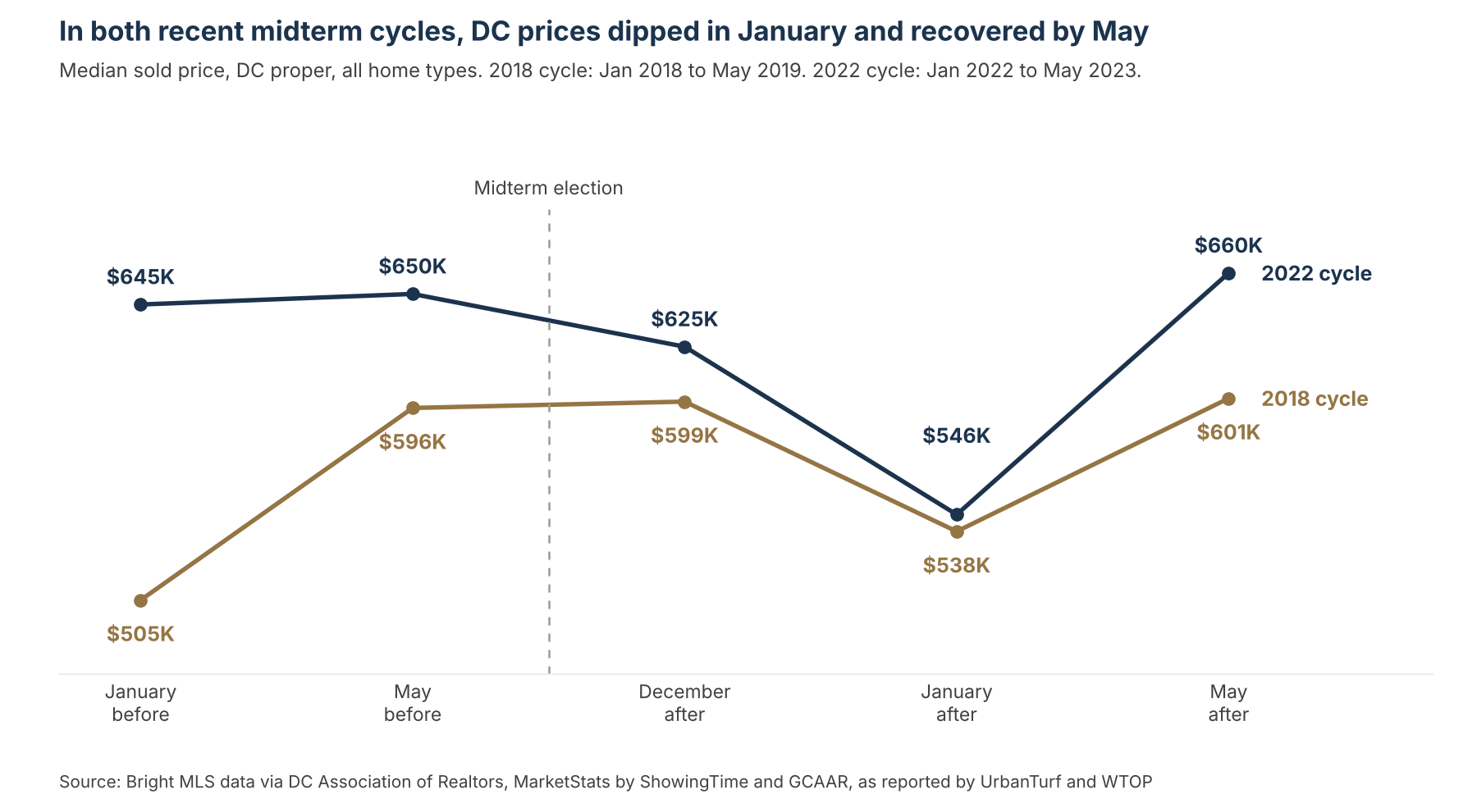
- After the 2018 midterms, DC metro prices set a December record (MarketStats) and hit a decade high by April 2019 (MarketStats), despite a 35-day federal shutdown.
- After the 2022 midterms, with rates near 7% as they are today, DC's median dipped to $546K in January 2023 and recovered to $677K by April (DC Association of Realtors). Prices dip in most Januarys, so this is expected and not necessarily the result of the election.
We are glad to walk through what this means for your home, your search or your portfolio.
Text/ Call: +1-202-412-4929
Email: [email protected]
Instagram: @andyandrewsmith